Returning to work after a psychological injury is rarely one decision made on one day. It is a series of small, connected moments: a conversation with a manager, a change to hours, a difficult morning, a plan review, a need for clearer support.
Too often, those moments live in different places. The plan is in one document. Appointments are in another calendar. Notes are scattered across emails. Support is available, but not always easy to find when it is needed.
SmartRTW is an early prototype exploring what it could feel like to bring those pieces together: not as another compliance portal or clinical tool, but as a calm companion for the return-to-work journey.
A place to begin
The prototype opens with a simple idea: before offering support, understand where someone is starting from.
A short guided conversation introduces the experience and helps shape the journey around the person’s current situation — whether they are away from work, preparing to return, adjusting hours and duties, or trying to sustain a return that has already begun.
That context matters. The next useful step for someone preparing for their first day back is different from the next useful step for someone who is overwhelmed halfway through their first week.
Rather than expecting people to know the process, SmartRTW is designed to make it visible one step at a time.
One journey, not six disconnected tools
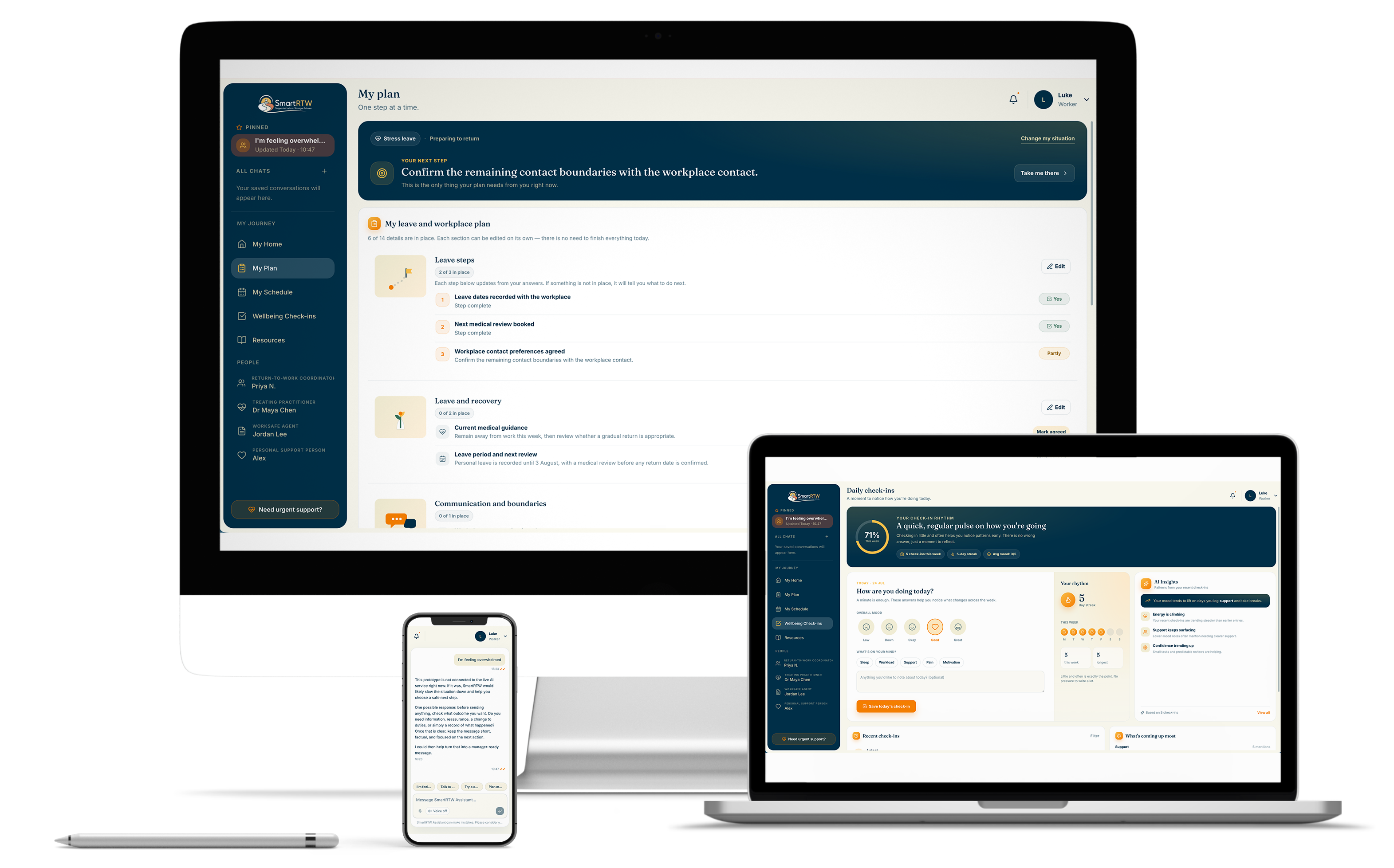
At the centre of the prototype is a simple navigation model: My Home, My Plan, My Schedule, Wellbeing Check-ins and Resources. Each section has its own purpose, but they are designed to work as one connected picture.
01My Plan
The return-to-work plan becomes something more useful than a static form. SmartRTW breaks it into clear, manageable details: current capacity, proposed duties, hours, workplace adjustments, the people involved and the next review date.
Instead of presenting an unfinished plan as a failure, the experience shows what is already in place and what needs attention next. A missing detail becomes a practical prompt: ask for the hours to be confirmed, agree on adjustments in writing, or book the next review.
The aim is not to score someone’s recovery. It is to make the arrangement easier to understand, discuss and keep current.
02My Schedule
Recovery has a rhythm. Meetings, appointments, plan reviews and small practical actions all compete for attention, particularly when energy is limited.
The schedule brings these commitments into view in one calm calendar. It can surface key return-to-work dates alongside reminders, check-ins and practical actions, so the journey does not have to be held entirely in someone’s head.
A return-to-work planning meeting is not just another event. It connects to the plan, the people involved and the actions that need to happen afterwards.
03Wellbeing Check-ins
Progress is not always linear, and a person’s wellbeing can shift long before a formal review meeting arrives.
Daily check-ins create a small, low-pressure space to notice how things are going. A person can record their mood, identify what is on their mind — workload, sleep, support, pain or motivation — and add a note if they want to.
Over time, these small reflections can reveal useful patterns: when work feels more manageable, what support is helping, and what might be worth raising before things become harder.
The point is not surveillance. It is self-awareness, built through a minute of reflection rather than another long form.
04Resources that meet the moment
The resources area turns information into something more approachable. Short learning modules cover the parts of return to work that can otherwise feel unclear: roles and responsibilities, workplace adjustments, safer conversations, managing overwhelm, progress reviews and support pathways.
The emphasis is practical. What might a quieter workspace make possible? How can someone ask for support without sharing more personal detail than they want to? Who should be involved when a plan needs to change?
Alongside learning, urgent and crisis support remains visible. In a space built around recovery, it is important that help is never buried behind a menu.
A conversation when words are hard to find
SmartRTW also explores a conversational starting point. Sometimes the first task is not completing a plan or reviewing a calendar. It is finding language for a difficult moment.
The assistant experience is designed to help someone slow things down: prepare a message to their manager, think through a workplace adjustment, plan a return, or find one small coping strategy for a hard day.
That is a deliberately human role for technology. Not to make clinical decisions or replace the people around someone, but to help turn an uncertain thought into a practical next step.
The support team stays in view throughout the experience: return-to-work coordinators, treating practitioners, managers, agents, family and trusted people. SmartRTW is built around the idea that returning to work is supported by relationships, not handled by an app alone.
Designed to travel with the person
The prototype is designed across desktop, tablet and mobile form factors because return to work does not happen only at a desk. Someone may want to look at their plan before a meeting, note how they are feeling on the way home, or revisit a resource when a conversation is approaching.
The experience should be there when it is useful, without demanding constant attention.
Early by design
This is an early prototype. It is a way of testing the shape, language and flow of a more supportive return-to-work experience before making claims about a finished product.
Some interactions use illustrative information and demo responses. The live AI service is not connected in this prototype, and the experience is not intended to provide medical advice, make clinical assessments or replace professional support.
But the questions it asks are real.
Can a return-to-work plan feel less intimidating when it is broken into clear next steps? Can wellbeing check-ins help people notice patterns earlier? Can better language make it easier to ask for an adjustment? Can the process feel more personal without becoming more complicated?
Where this is heading
SmartRTW is an exploration of a different kind of digital support: one that makes room for uncertainty, treats progress as something that can be adjusted, and keeps practical action connected to wellbeing.
The prototype is only the beginning. Its purpose is to learn what helps people feel clearer, more supported and more able to take the next step — whatever that step needs to be.
“Because a sustainable return to work is not about pushing through. It is about finding a pace, a plan and a support network that make recovery possible.”
Curious about the build?
For partnership conversations, research questions, or to learn more about how SmartRTW is being developed, we’d love to hear from you.
Start a conversation